What Is a Dealership Management System? Why AI-Powered DMS Is the Future of Automotive Retail
Running a dealership today means juggling sales, service, inventory, accounting, and customer relationships — often across disconnected spreadsheets, paper registers, and standalone tools. A dealership management system (DMS) solves this by bringing every department onto one connected platform. If you've ever wondered what a dealership DMS actually does and why more dealers are switching to cloud and AI-based systems, this guide breaks it down. It's the platform that connects sales, service, inventory, accounting, and customer data into one system instead of a dozen disconnected tools. If you've ever wondered what a dealership DMS actually does, why so many dealers are switching platforms right now, and what to look for in an automotive dealership management system, this guide covers it in detail.
What Is a Dealership Management System (DMS)?
A dealership DMS is purpose-built software that runs the day-to-day operations of an automotive dealership from a single platform. Instead of tracking leads in a CRM, vehicle stock in a spreadsheet, service jobs on paper job cards, and finances in a separate accounting tool, a dealership DMS system puts all of it in one place — with every department pulling from the same live data.
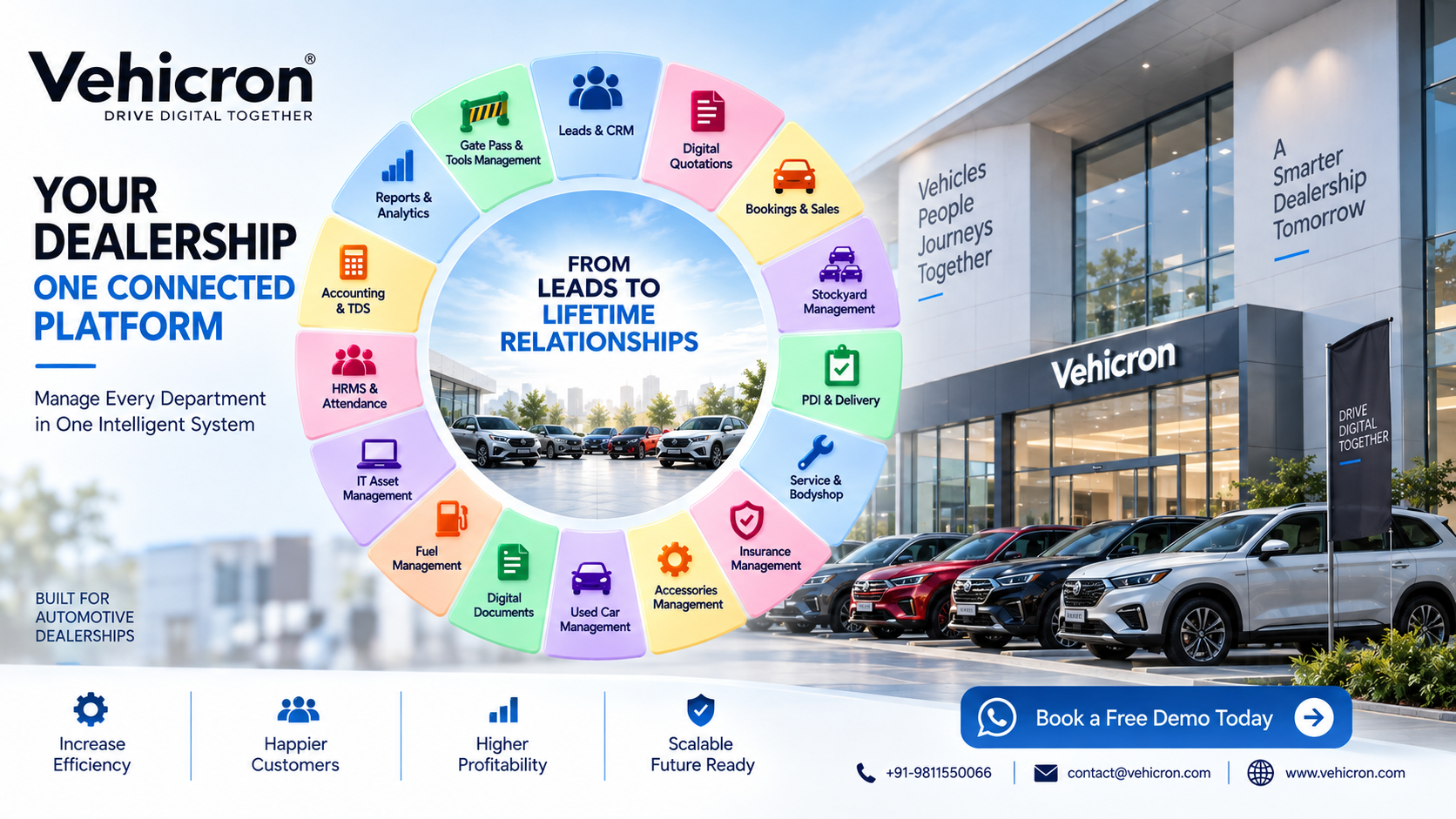
For a business as operationally layered as a dealership, this matters more than it might sound. A single vehicle touches sales, finance, the stockyard, the service bay, accounting, and sometimes HR before a deal is fully closed. When these functions live in separate systems, information gets duplicated, delayed, or lost between departments. A dealership management system removes those gaps by giving every team — and every manager — the same real-time picture of the business.
Why Dealerships Need a DMS
Dealerships that still run on spreadsheets, WhatsApp groups, and paper registers tend to hit the same operational walls as they grow:
- No real-time visibility into which vehicles are in stock, in transit, or under service
- Manual reconciliation between sales, accounts, and inventory records that eats up hours every week
- Slow follow-ups on leads because sales data isn't connected to CRM reminders
- Paperwork bottlenecks at delivery, gate pass, and invoicing stages
- No single owner-level dashboard to see how the dealership is actually performing
A dealership management system fixes this by centralizing data and automating the handoffs between departments, so nothing depends on someone remembering to update a spreadsheet or forward an email.
Core Modules of an Automotive Dealership Management System
While every DMS system is built slightly differently, a complete automotive dealership management system typically covers:
- Stockyard & Inventory Management – real-time tracking of vehicles from arrival through allocation and delivery
- Sales & CRM – lead capture, follow-up scheduling, test drives, quotations, and deal closure in one pipeline
- Service & Bodyshop – job cards, technician scheduling, parts availability, and repair status tracking
- Accounting & Billing – invoicing, payments, and financial reporting without manual reconciliation between departments
- HR & Payroll – staff attendance, payroll processing, and performance tracking within the same ecosystem
- Document Vault – centralized, paperless storage for RC books, insurance papers, and customer documents
- Gate Pass Management – secure, logged tracking of vehicle movement in and out of the premises
- Customer Feedback – structured capture of service and sales satisfaction data to close the loop with customers
- Fuel Management – tracking fuel costs and consumption across the dealership's fleet and test-drive vehicles
- Test Drive Management – scheduling, tracking, and follow-up on test drives tied directly to the sales pipeline
- Used Cars – dedicated workflows for evaluation, pricing, and resale of pre-owned inventory
- Tools Management – tracking of workshop tools and equipment to prevent loss and downtime
When these modules sit on one connected platform instead of ten standalone tools, a dealer gets visibility that simply isn't possible otherwise — and the dealership stops losing hours every week to duplicate data entry and manual cross-checking.
Legacy DMS vs. Cloud-Based Dealership Management Systems
Legacy, on-premise dealership DMS software comes with real, recurring costs: physical servers that need maintenance, manual software updates, rigid multi-year contracts, and data that stays locked inside one location's infrastructure. Switching providers later often means expensive, painful data migration.
A modern cloud-based dealership management system removes that burden entirely:
- Accessible from any device, from any location, without on-site servers
- Updates and new features roll out automatically, with no IT overhead
- Scales up or down as the dealership adds outlets or staff
- Keeps every branch's data synced in real time, not just at end-of-day
For dealer groups running multiple outlets, this shift alone can cut coordination overhead dramatically — there's no more waiting on end-of-day reports from each branch to know what's actually happening across the business.
The Shift Toward AI-Based Dealership Management Systems
The next evolution of the dealership DMS goes beyond the cloud. An AI-based dealership management system doesn't just store and display data — it acts on it. Where a traditional DMS shows you a report, an AI-native platform can:
- Flag slow-moving inventory before it becomes a carrying cost
- Predict service bay bottlenecks before they cause delays
- Auto-route leads to the right salesperson based on availability and history
- Surface next-best actions instead of leaving staff to dig through dashboards
- Highlight anomalies in accounting or inventory data before they become bigger problems
This turns the DMS from a passive back-office record-keeper into a system that actively helps dealership owners and managers make faster, better-informed decisions — without having to interpret every report themselves.
Vehicron: A Cloud-Based, AI-Native Dealership Management System
Vehicron is a AI-based automotive dealership management system built around this shift toward intelligent, connected operations. Rather than retrofitting AI onto an old architecture, Vehicron is designed AI-native from the ground up, with 14 connected modules covering the full dealership lifecycle — from stockyard and sales to service, accounting, HR, document management, and customer feedback.
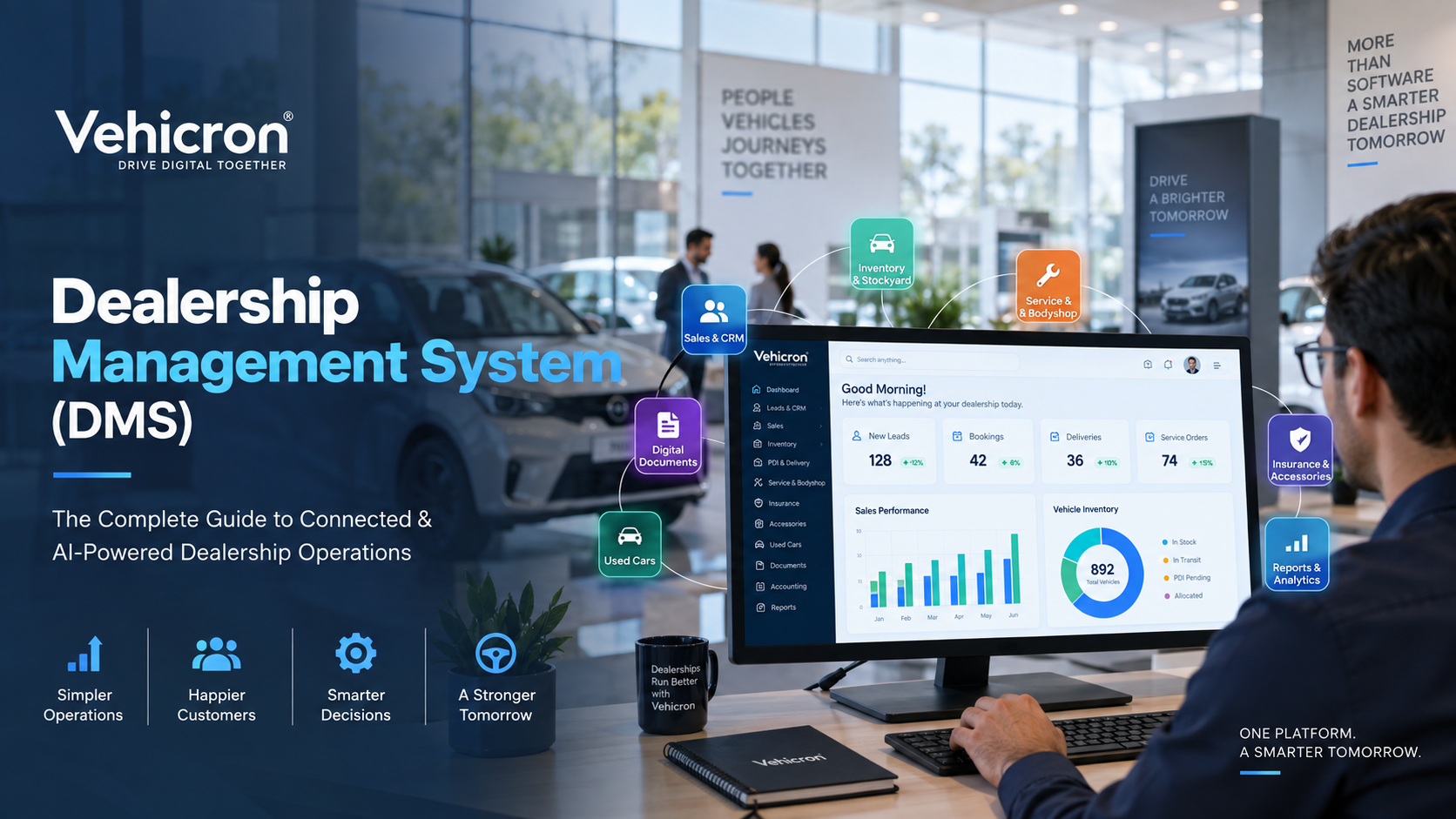
Dealers using Vehicron have reported measurable operational gains: faster vehicle delivery, a sharp drop in paperwork, full visibility into vehicle movement across the dealership, and noticeably less time lost to cross-department coordination. Because every module shares the same live data, dealership owners get a single dashboard view of the entire operation instead of chasing updates from five different tools and three different people.
How to Choose the Right Dealership DMS System
When evaluating a dealership management system, it helps to look past the feature checklist and ask:
- Is it truly cloud-native, or is it a legacy system with a cloud login bolted on top?
- Does it connect every department — sales, service, accounts, HR — or just sales and inventory?
- Is there real AI driving insights and automation, or is "AI" just a marketing label on the same old reports?
- How smooth is onboarding, and what does ongoing support actually look like after go-live?
- Can it scale as the dealership adds locations, staff, or vehicle lines?
A dealership DMS is a long-term operational decision, not just a software purchase. The right platform should grow with the dealership, not hold it back a few years in.
Frequently Asked Questions
1. What is a dealership management system in simple terms? A dealership management system is software that connects a dealership's sales, service, inventory, and accounting functions into one platform, so every department works from the same real-time data instead of separate spreadsheets or tools.
2. What is the difference between a DMS and a CRM? A CRM (Customer Relationship Management tool) focuses specifically on managing leads, customer interactions, and follow-ups. A dealership DMS is broader — it includes CRM functionality but also covers inventory, service, accounting, HR, and document management across the entire dealership.
3. Is a cloud-based dealership management system secure? A well-built cloud DMS is generally more secure than legacy on-premise systems, since data is centrally managed, backed up automatically, and protected by dedicated infrastructure rather than a single on-site server that depends on manual maintenance.
4. How is an AI-based dealership management system different from a regular DMS? A regular DMS mainly stores and displays data for staff to interpret manually. An AI-based dealership management system actively analyzes that data — flagging slow-moving stock, predicting service delays, and routing leads automatically — so decisions happen faster and with less manual effort.
5. How long does it take to switch to a new dealership DMS system? Timelines vary by dealership size and data complexity, but a modern cloud DMS is typically faster to onboard than a legacy system, since there's no on-site server setup — most of the work is data migration, module configuration, and staff training.
The Bottom Line
A dealership management system is no longer optional infrastructure — it's the foundation that determines how efficiently a dealership runs and how well it serves customers. As the industry moves from legacy systems to cloud- and AI-native platforms, dealers who make the switch early gain a real, measurable operational edge over those still running on spreadsheets and paper.
To see how a modern, AI-native automotive dealership management system works in practice, visit Vehicron's Dealership Management System page.
